
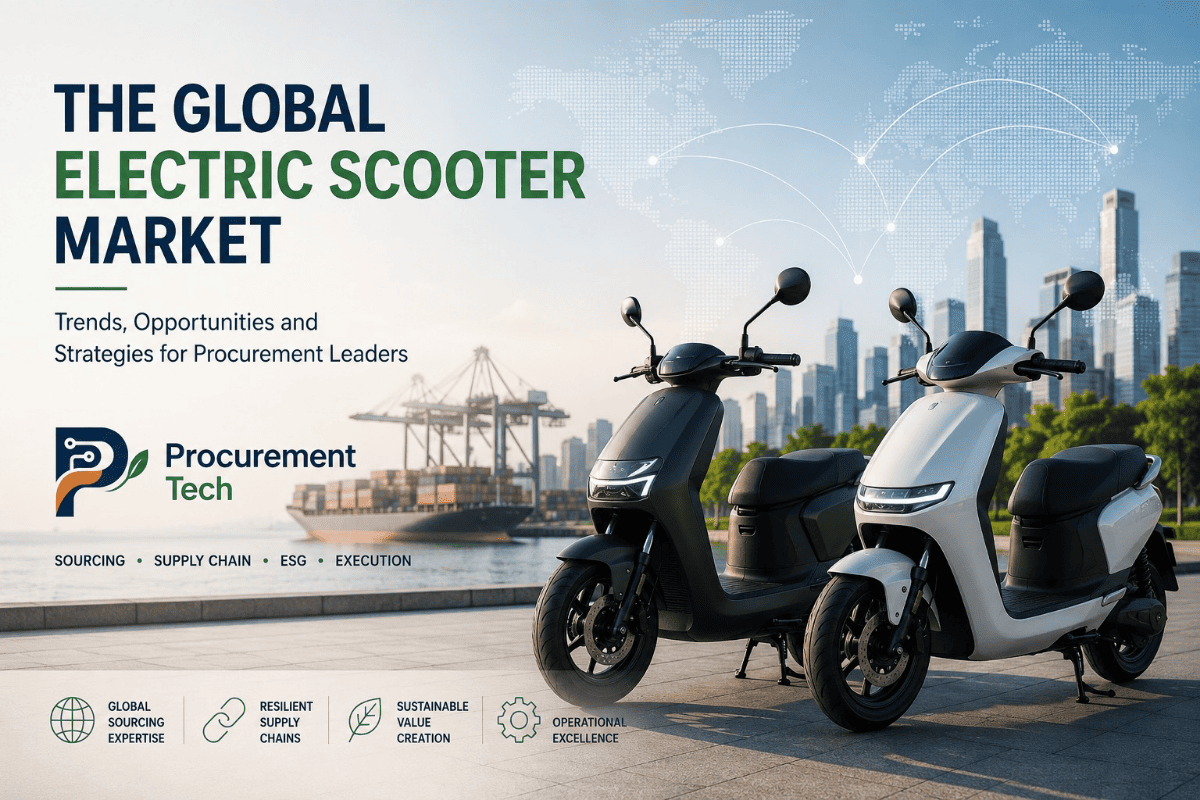
Electric mobility is no longer an emerging trend—it is rapidly becoming a fundamental component of modern transportation.
Driven by urbanisation, sustainability targets, rising fuel costs and the continued growth of e-commerce, electric scooters and e-bikes are reshaping urban mobility across developed and emerging economies alike.
For procurement and supply chain professionals, this represents more than a product opportunity. It is an evolving ecosystem where sourcing strategy, supplier resilience and after-sales capabilities will determine long-term success.
🌍 Global Market Overview
The global electric scooter market continues to expand at a remarkable pace, supported by increasing consumer adoption and government investment in sustainable transport.
Key market drivers include:
- Urban congestion driving demand for compact mobility solutions
- Rising fuel and transport costs
- Net Zero commitments and emissions reduction policies
- Expansion of last-mile delivery services
- Improvements in battery technology and vehicle performance
As cities invest in greener transport infrastructure, demand is becoming increasingly structural rather than cyclical.
🇨🇳 China Remains the Manufacturing Powerhouse
China continues to dominate global production, offering scalable manufacturing capacity, competitive pricing and a mature supplier ecosystem.
Its advantages include:
- High-volume manufacturing
- Integrated battery supply chains
- Extensive component availability
- Competitive production costs
- Continuous product innovation
For international buyers, China remains the primary sourcing destination, although supplier diversification is becoming an increasingly important procurement strategy.
🌎 Growing Import Markets
Demand is expanding well beyond traditional developed markets.
Mature Markets
Major importing regions include:
- 🇺🇸 United States
- 🇬🇧 United Kingdom
- 🇪🇺 European Union
These markets continue to favour premium products featuring longer battery life, enhanced safety systems and connected technologies.
Emerging Markets
Countries experiencing rapid adoption include:
- 🇧🇷 Brazil
- 🇳🇬 Nigeria
- 🇬🇭 Ghana
- 🇦🇴 Angola
Growth is largely driven by:
- Last-mile delivery services
- Informal transport sectors
- Affordable urban mobility
- Limited public transport infrastructure
These markets present significant opportunities for distributors capable of building strong local support networks.
💰 Where the Real Value Is Created
Importing electric scooters is only part of the value proposition.
Distributors typically achieve gross margins between 20% and 50%, depending on:
- Brand positioning
- Product quality
- Battery performance
- Warranty programmes
- Spare parts availability
- After-sales service
Premium models equipped with high-quality lithium-ion batteries, extended range and smart connectivity continue to command stronger margins and greater customer loyalty.
📈 Key Trends Shaping the Market
Several structural trends are expected to define the industry’s evolution over the coming years.
🚚 Growth of Last-Mile Delivery
Food delivery platforms, courier operators and logistics providers continue to expand electric fleets to improve operational efficiency and reduce emissions.
⚖️ Regulation and Government Incentives
Governments are increasingly introducing regulations, incentives and infrastructure investments to accelerate electric mobility adoption.
🔋 Better Battery Technology
Lithium-ion batteries continue to improve in terms of:
- Range
- Charging speed
- Durability
- Lifecycle performance
Battery quality is becoming one of the most important purchasing criteria.
🏢 Expansion of Fleet Sales
Business-to-business (B2B) demand is growing faster than traditional consumer retail.
Corporate fleet operators increasingly require:
- Fleet management platforms
- Predictive maintenance
- Financing options
- Service-level agreements
🌱 ESG and Supply Chain Considerations
As electric mobility scales globally, ESG requirements are becoming increasingly important throughout the value chain.
Procurement teams should evaluate suppliers based on:
- Battery sourcing transparency
- Environmental compliance
- Ethical labour standards
- Product quality certifications
- End-of-life battery recycling programmes
Companies that integrate ESG criteria into supplier selection are likely to reduce long-term operational and reputational risks.
🎯 Strategic Implications for Procurement
Success in the electric mobility sector is no longer determined solely by product pricing.
Competitive advantage increasingly depends on:
✔ Diversified sourcing strategies
✔ Strong supplier relationships
✔ Local distribution capabilities
✔ Robust after-sales support
✔ Spare parts availability
✔ Inventory optimisation
✔ Financing and leasing solutions
✔ Long-term supply chain resilience
The organisations that build complete mobility ecosystems—not simply distribution channels—will be best positioned to capture sustainable market growth.
📌 Conclusion
The global electric scooter market is entering a phase of sustained structural expansion.
While manufacturing scale remains concentrated in Asia, growth opportunities are emerging worldwide as cities embrace cleaner, smarter and more efficient mobility solutions.
For procurement professionals, success will depend on balancing cost competitiveness with supplier reliability, ESG performance and resilient supply chain design.
At Procurement Tech, we help organisations transform sourcing opportunities into scalable commercial strategies through supplier qualification, international procurement expertise and resilient supply chain solutions.
📞 Contact Procurement Tech
If your organisation is exploring global sourcing, supplier qualification, distribution partnerships or market entry strategies within the electric mobility sector, our team can help you identify opportunities and mitigate supply chain risks.
#ElectricMobility #EV #ElectricScooters #SupplyChain #Procurement #StrategicSourcing #GlobalTrade #LastMileDelivery #ESG #UrbanMobility #BatteryTechnology #BusinessGrowth
0 Comments