
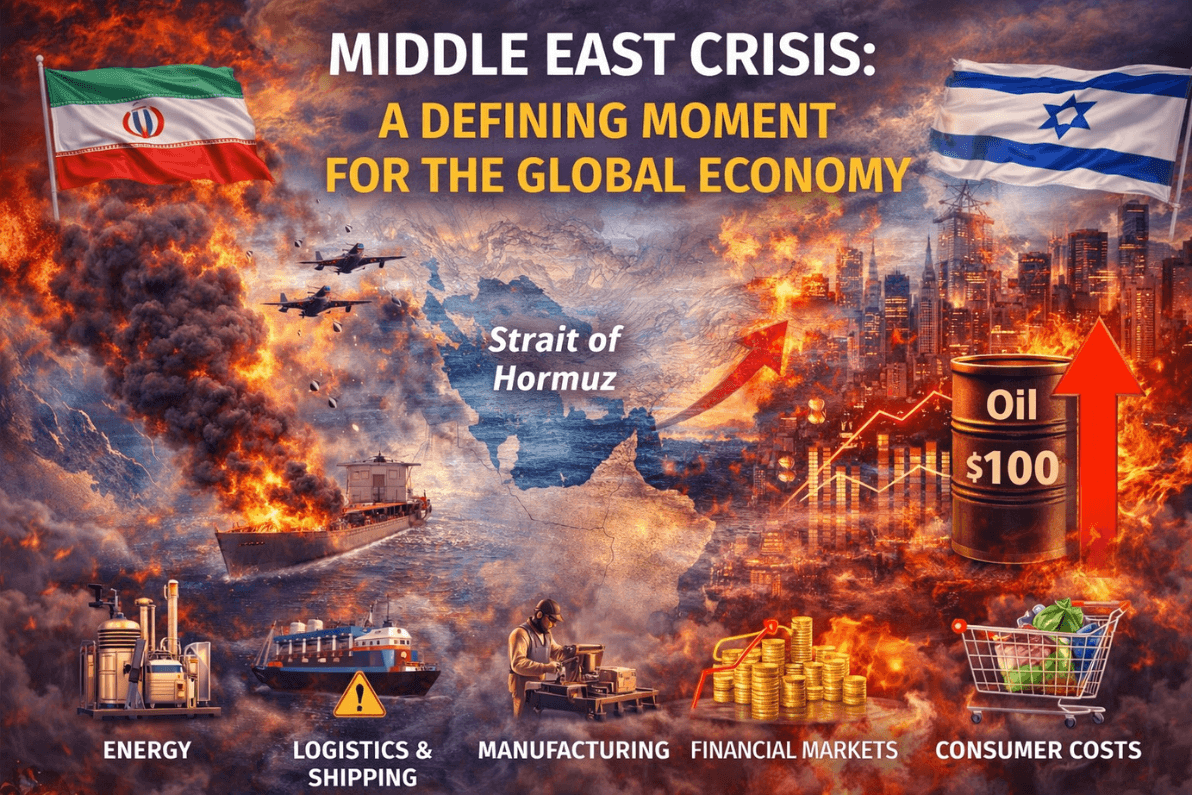
The escalation of the US–Israel conflict involving Iran has evolved into one of the most consequential geopolitical events in recent decades particularly following the effective closure of the Strait of Hormuz, the world’s most critical energy chokepoint.
To put this into perspective, approximately 20% of global oil supply and a significant share of global LNG flows transit through this narrow corridor. Its disruption is not regional ,it is systemic.
For businesses, this is no longer a geopolitical headline. It is a direct supply chain, cost and risk management issue.
Energy Markets: From Fundamentals to Geopolitics
Oil prices have surged above $100 per barrel, with further upside risk depending on the duration and severity of disruption.
Energy markets are now driven less by supply-demand fundamentals and more by geopolitical developments.
Key implications:
-
Increased input costs across industries
-
Heightened volatility in energy procurement
-
Elevated inflationary pressure globally
Logistics & Shipping: Network Disruption
Tanker traffic through the Strait of Hormuz has significantly reduced, with vessels either stranded, delayed or forced to reroute.
Consequences include:
-
Sharp increases in marine insurance premiums
-
Extended transit times and route inefficiencies
-
Congestion across alternative shipping corridors
Global logistics networks are now operating under heightened stress conditions.
Manufacturing: Immediate Cost Transmission
Energy and raw material price increases are feeding directly into industrial production costs.
Energy-intensive sectors including:
-
Chemicals
-
Metals
-
Plastics
-
Heavy manufacturing
are experiencing immediate margin compression.
For procurement teams, cost visibility and supplier engagement are now critical.
Financial Markets: Volatility and Repricing
Financial markets are reacting rapidly to uncertainty:
-
Increased volatility across equities and commodities
-
Capital flows shifting toward safe-haven assets
-
Inflation expectations being revised upward
The crisis is triggering a repricing of risk across global markets.
Consumer Goods & Inflation: Downstream Impact
Energy and logistics shocks are cascading through supply chains, ultimately impacting consumer-facing sectors.
Impacts include:
-
Rising production and distribution costs
-
Price increases across goods categories
-
Pressure on consumer purchasing power
Inflation is no longer theoretical it is being transmitted in real time.
Aviation & Travel: Cost and Route Disruption
Airspace risks and fuel price increases are forcing airlines to adjust routes and absorb higher operational costs.
This results in:
-
Increased ticket prices
-
Reduced efficiency in global mobility
-
Additional strain on aviation sector margins
Renewables & Energy Transition: Acceleration Trigger
This crisis reinforces a critical strategic reality:
Energy security is national security.
As a result, we can expect:
-
Accelerated investment in renewable energy
-
Increased focus on energy diversification
-
Reduced dependence on geopolitical chokepoints
The long-term impact may be a faster transition toward decentralised and resilient energy systems.
What This Means for Procurement & Supply Chain Leaders
This is not a short-term disruption — it is a structural risk event.
Procurement and supply chain teams must respond with urgency and discipline:
-
Diversifying supplier bases across geographies
-
Stress-testing supply chains against geopolitical scenarios
-
Implementing dynamic sourcing strategies
-
Reviewing energy procurement frameworks
-
Strengthening inventory and logistics resilience
-
Integrating geopolitical risk into ESG and governance models
Organisations that actively manage risk will outperform those that react passively.
Conclusion
The current Middle East crisis represents more than a regional conflict it is a systemic shock to global trade, energy markets and inflation dynamics.
In this environment, resilience is no longer optional. It is a competitive advantage.
At Procurement Tech, we support organisations in transforming geopolitical uncertainty into structured sourcing strategies and supply chain resilience frameworks.
#Geopolitics #MiddleEast #SupplyChain #EnergyMarkets #RiskManagement #GlobalEconomy #Procurement #StrategicSourcing

0 Comments