
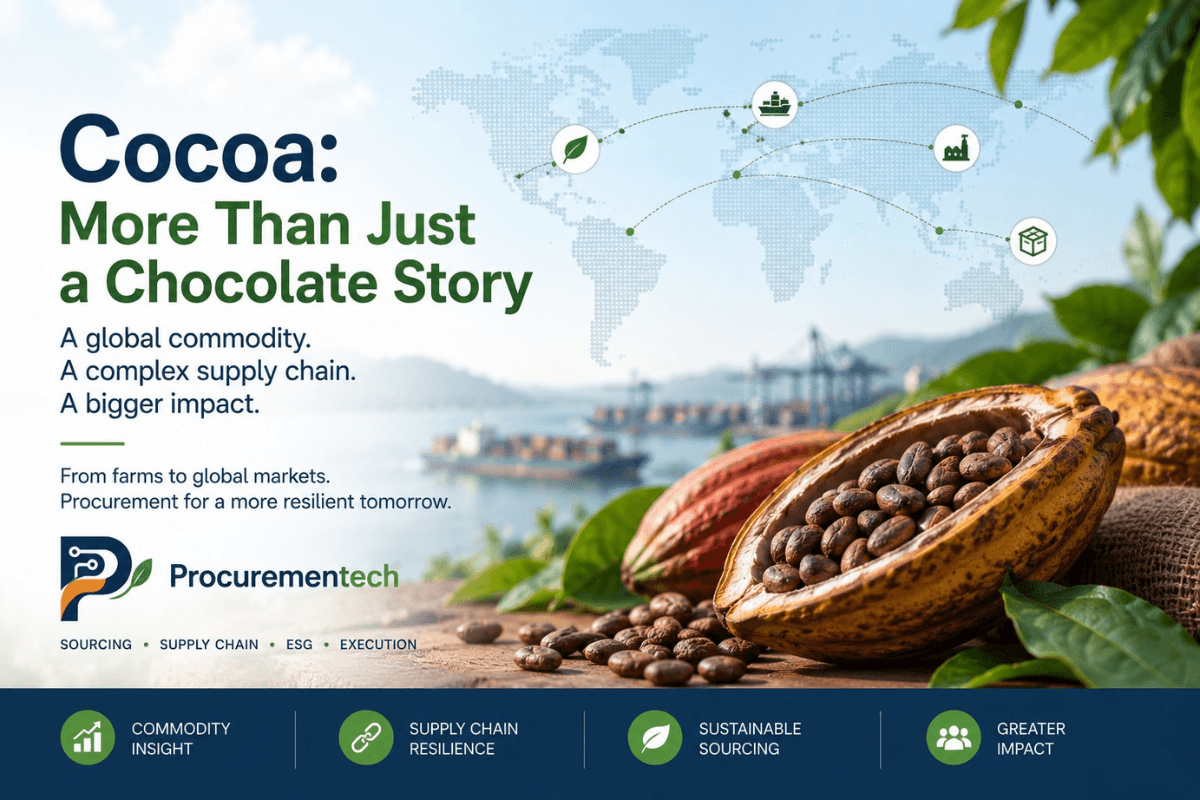
Cocoa is a powerful example of how disruption in one agricultural commodity can spread far beyond the product consumers immediately associate with it.
For most people, cocoa means chocolate.
For procurement and supply chain professionals, however, cocoa represents something much bigger: commodity exposure, geographic concentration, climate risk, logistics, traceability, regulation and supplier resilience.
After the extreme market conditions of 2024 and 2025, the cocoa market has entered a different phase. Supply has shown signs of recovery, but the underlying vulnerabilities that contributed to the crisis have not disappeared.
The lesson for procurement is important:
A falling commodity price does not necessarily mean that supply-chain risk has disappeared.
From Historic Shortage to a Fragile Recovery
The scale of the recent cocoa disruption was extraordinary.
For the 2023/24 season, the global cocoa market recorded a deficit of approximately 489,000 tonnes. The following season brought some relief: the ICCO’s latest estimate puts 2024/25 global production at approximately 4.73 million tonnes, with grindings at around 4.65 million tonnes and a modest supply surplus of approximately 37,000 tonnes.
That recovery matters, but it should not be confused with a return to a structurally low-risk market.
Recent ICCO analysis indicates that cocoa futures remain highly sensitive to changes in demand, weather developments and production risks in major producing countries.
For buyers, the focus therefore needs to move beyond the spot price.
The more important question is:
How resilient is the supply behind that price?
Where Does the World’s Cocoa Come From?
Cocoa production is one of the most geographically concentrated agricultural supply chains in the world.
West Africa has historically supplied around 70% or more of global cocoa, with Côte d’Ivoire and Ghana together accounting for more than 60% in recent historical production data.
That concentration creates significant efficiency — but also systemic exposure.
A combination of adverse weather, crop disease, ageing trees, inadequate farm investment or logistics disruption in a relatively small geographic area can influence prices and availability across the entire global chocolate industry.
During the 2023/24 crisis, the ICCO identified unfavourable weather, black pod disease and Cocoa Swollen Shoot Virus Disease among the factors affecting production.
This is a classic procurement concentration risk.
Europe Sits at the Centre of the Processing Market
Europe plays a particularly important role in the global cocoa value chain.
In the 2023/24 season, Europe represented approximately 37% of global cocoa grindings, making it the largest processing region.
Within Europe, the Netherlands has long played a central role in cocoa trading, importing and processing, supported by its logistics infrastructure and access to major European consumer markets.
This creates an interconnected supply chain:
West African farms → exporters → ports → European processors → food manufacturers → retailers → consumers.
A disruption at almost any point can therefore propagate through multiple industries and markets.
The Next Procurement Challenge: Timing and Logistics
One of the most important developments for procurement teams to monitor is the start of Côte d’Ivoire’s 2026/27 main crop.
Industry sources reported in August that poor weather, insufficient farm maintenance and an unusually strong mid-crop could delay significant volumes from the new main crop by approximately eight to ten weeks.
Around 900,000 tonnes were expected to reach Ivorian ports between October and December 2026, compared with roughly 1.1 million tonnes during the same period a year earlier. A later concentration of arrivals could create congestion at Abidjan and San Pedro and put additional pressure on storage and shipping capacity.
This illustrates an important procurement principle:
Supply availability and supply accessibility are not the same thing.
A commodity may exist physically, but port congestion, documentation, storage capacity or transport constraints can still prevent it from reaching manufacturers when required.
EUDR Is Turning Traceability into a Procurement Requirement
The European regulatory environment adds another layer of complexity.
Cocoa is one of the seven commodity groups covered by the EU Deforestation Regulation (EUDR). Under the current implementation timetable, the regulation begins applying from 30 December 2026 for large and medium-sized operators, with later application for most micro and small operators. Companies placing covered products on the EU market or exporting them must demonstrate that they are deforestation-free and legally produced.
For cocoa procurement, this changes the meaning of supplier qualification.
Buyers increasingly need visibility beyond the immediate supplier into:
- Farm origin
- Geographic traceability
- Chain of custody
- Supplier documentation
- Deforestation exposure
- Compliance systems
- Data quality
And implementation is not purely theoretical.
In September 2026, cocoa traders and cooperatives in Côte d’Ivoire were reported to be experiencing difficulties adapting to a new national electronic traceability system designed partly to prepare the supply chain for European requirements.
For procurement teams, traceability is becoming part of supply continuity.
How the Chocolate Industry Responds to Commodity Volatility
When the price of a critical ingredient rises dramatically, procurement has several options.
Simply negotiating harder with suppliers is rarely enough.
Manufacturers may need to reconsider:
- Product specifications
- Pack sizes
- Cocoa content
- Recipes and formulations
- Supplier portfolios
- Sourcing origins
- Contract structures
- Inventory levels
- Hedging strategies
- Alternative ingredients
This is where procurement moves from purchasing into strategic business management.
A commodity shock can ultimately influence not only the purchase price, but also product development, manufacturing, working capital, pricing and brand strategy.
Six Priorities for Cocoa Procurement
For businesses with significant cocoa exposure, several areas deserve particular attention:
- Diversify supply where technically and commercially possible. Geographic concentration should be understood and actively managed.
- Build stronger supplier relationships. Long-term partnerships can provide better visibility into crops, availability and emerging risks.
- Strengthen traceability. Origin and chain-of-custody information are increasingly operational requirements, particularly for European supply chains.
- Monitor crops, not just commodity screens. Weather, disease, port arrivals and farm conditions can provide earlier signals than headline market prices.
- Review inventory strategy. Safety stock can provide resilience, but excessive inventory introduces working-capital and price risk.
- Connect procurement with R&D and commercial teams. Specifications and formulations can sometimes provide greater risk mitigation than price negotiation alone.
ESG Is Also a Supply-Chain Issue
Cocoa’s ESG challenges cannot be separated from procurement.
Millions of farmers depend on cocoa production, many operating as smallholders, while the sector faces interconnected issues involving farmer incomes, productivity, ageing plantations, deforestation, climate resilience and traceability. ICCO research estimates that cocoa is cultivated by roughly five to six million farmers globally, with a large proportion being smallholders.
Responsible sourcing therefore needs to go beyond supplier declarations.
Procurement teams should increasingly consider whether their sourcing model supports:
traceability + compliance + productivity + environmental resilience + long-term supplier viability.
A supply chain cannot be genuinely resilient if the economics at its origin are unsustainable.
Procurementech Executive Insight
The cocoa market provides a valuable lesson for procurement leaders.
During periods of shortage, organisations naturally focus on price.
But price is only the visible expression of a much broader system.
Behind it sit weather, agricultural productivity, supplier concentration, logistics capacity, regulation, inventory, traceability and farmer economics.
The strongest procurement organisations therefore do not simply ask:
“What will cocoa cost?”
They also ask:
“Where could our supply chain fail — and what can we change before it does?”
That distinction is what separates transactional buying from strategic procurement.
Conclusion: Cocoa Is a Supply-Chain Story
Cocoa may ultimately reach consumers through chocolate, confectionery and food products, but its journey begins thousands of kilometres earlier.
The recent market crisis demonstrated how quickly agricultural disruption can move through global supply chains.
Prices may ease. Supply may recover. Market balances may improve.
But the structural issues remain.
Climate exposure, concentrated production, ageing plantations, logistics constraints, regulatory change and traceability requirements mean cocoa will continue to require active procurement management.
For companies exposed to the category, the objective should therefore move beyond simply securing the lowest price.
It should be to build a supply chain capable of absorbing the next disruption.
At Procurementech, we help organisations turn commodity uncertainty into practical procurement action through strategic sourcing, supplier qualification, supply-chain risk management, ESG integration and operational execution.
Cocoa may be a chocolate story — but it is also a procurement, resilience and supply-chain story.

0 Comments