
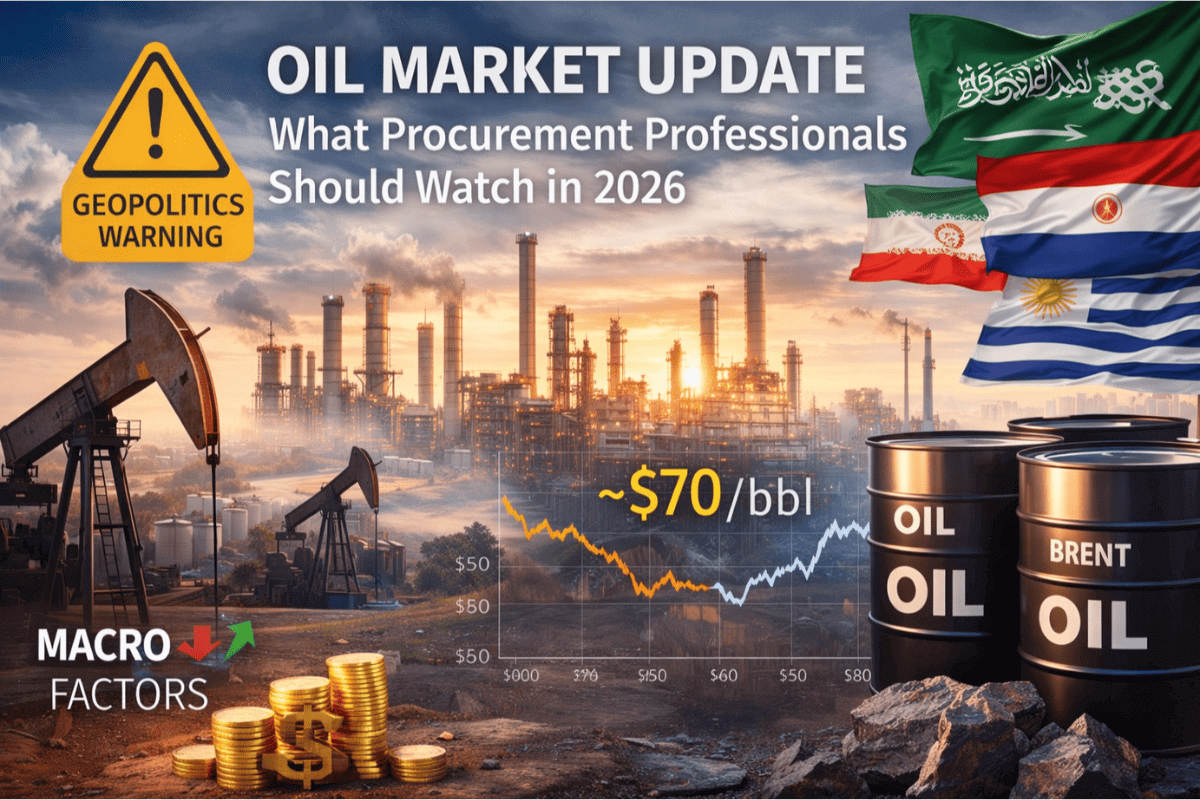
Oil markets in early 2026 continue to reflect a delicate balance between structural fundamentals and geopolitical uncertainty.
Brent crude is currently trading around the ~$70 per barrel mark, supported primarily by geopolitical tensions. However, underlying supply data suggests that global production remains structurally strong.
For procurement professionals, the question is not just “where is oil trading?” — but rather, what risks are embedded in the price and how should sourcing strategies adapt?
🔎 Key Oil Market Drivers
1️⃣ Supply vs Demand Balance
Global production growth continues to outpace demand expansion. While oil consumption is increasing modestly, particularly in emerging markets, supply remains relatively comfortable.
This structural supply strength limits sustained upward price momentum and suggests that significant price spikes require external shocks rather than pure fundamentals.
2️⃣ Geopolitical Risk Premium
Tensions in the Middle East, stricter sanctions enforcement and occasional tanker disruptions are injecting short-term volatility into markets.
However, markets are currently pricing in risk — not scarcity. The premium reflects uncertainty, not yet a physical shortage of supply.
For energy-intensive industries, this distinction is critical.
3️⃣ Macro & Policy Signals
Oil price movements are increasingly amplified by:
-
Global inventory trends
-
Central bank policy direction
-
Currency movements, particularly USD strength or weakness
-
Broader macroeconomic growth expectations
In short, financial variables are currently as influential as physical fundamentals.
📈 6-Month Outlook (Base Case Scenario)
For the next six months, the most probable scenario appears to be:
-
Range-bound Brent: ~$55–$65 per barrel
-
Periodic rallies driven by geopolitical headlines
-
Downside pressure if supply surplus persists
While Brent is currently near $70/bbl, underlying supply conditions suggest limited structural support at higher sustained levels without escalation risk.
📊 Scenario Analysis
🔹 Base Case
Stable trading range with episodic volatility driven by political developments.
🔹 Bearish Case
Persistent oversupply combined with weaker global growth could push prices toward the low-$50 range.
🔹 Bullish Shock Scenario
A major geopolitical escalation could trigger temporary spikes toward $70–$75 per barrel.
However, without structural supply disruption, sustained higher pricing remains less probable.
🎯 What This Means for Procurement & Supply Chain Teams
For procurement leaders, 2026 requires disciplined commodity risk management.
Key actions include:
-
Implementing indexed pricing structures
-
Strengthening energy hedging strategies where appropriate
-
Diversifying supplier exposure in energy-intensive categories
-
Stress-testing cost models under multiple oil price scenarios
-
Embedding energy risk into broader ESG and resilience planning
Energy markets remain volatile — but volatility creates opportunity for organisations with structured sourcing strategies.
🔎 Conclusion
The oil market in 2026 is not defined by shortage — it is defined by uncertainty.
Companies that combine market intelligence with proactive procurement execution will be best positioned to manage cost exposure and protect supply continuity.
At Procurement Tech, we help organisations translate commodity volatility into structured, resilient sourcing strategies.

0 Comments