
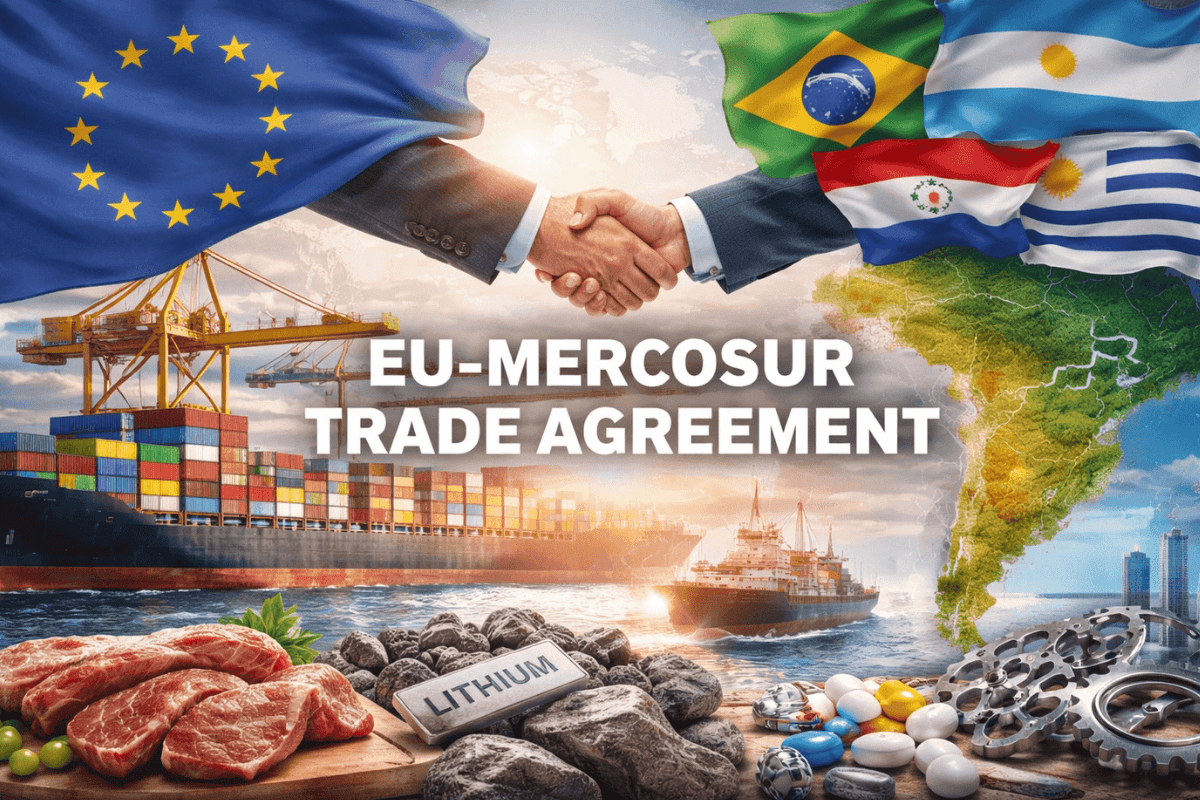
The EU-Mercosur trade agreement has the potential to reshape supply chains across markets representing more than 700 million consumers and nearly €20 trillion in combined GDP.
For businesses, this is not about politics — it is about market access, sourcing opportunities and competitive positioning in a rapidly evolving global trade environment.
🌎 Mercosur: Export Acceleration and Strategic Positioning
The Mercosur bloc stands to benefit significantly in export-led sectors, particularly those aligned with European industrial demand.
Agribusiness
Beef export quotas to the EU could increase by up to 99,000 tonnes per year, favouring producers capable of meeting stringent EU requirements on traceability, sustainability and ESG compliance.
Opportunity: higher volumes, but with increased regulatory scrutiny.
Mining and Critical Raw Materials
Brazil already exports more than €5 billion in iron ore to the EU. Meanwhile, Argentine lithium is becoming strategically vital to Europe’s electric vehicle (EV) and battery supply chains.
Opportunity: deeper integration into Europe’s energy transition ecosystem.
Automotive Manufacturing
Vehicle tariffs of up to 35% are expected to be gradually reduced, improving the competitiveness of Mercosur-based production and stimulating new trade flows.
🇪🇺 European Union: Industrial Expansion and Market Access
For the European Union, the agreement represents enhanced access to South American markets that have historically been protected by high tariff barriers.
Automotive and Industrial Machinery
EU manufacturers gain improved cost competitiveness in Mercosur markets, supporting export growth and margin expansion.
Pharmaceuticals and Chemicals
Current tariffs of up to 14% could be reduced or eliminated, accelerating market entry and enhancing profitability.
Engineering, Infrastructure and Services
Sectors such as:
-
Infrastructure
-
Logistics
-
Renewable energy
-
Digital services
are well positioned to scale operations across Mercosur markets.
⚖️ The Catch: Operational Complexity
While the opportunity is clear, execution is complex.
Key challenges include:
-
Identifying and qualifying new cross-border suppliers
-
Managing ESG scrutiny and sustainability compliance
-
Navigating regulatory differences
-
Mitigating logistics and transport risk
-
Managing currency exposure
This is where procurement shifts from operational to strategic.
🎯 Why Strategic Procurement Is the Real Differentiator
Trade agreements open doors.
Procurement determines who successfully walks through them.
At Procurement Tech, we support EU and Mercosur businesses in transforming trade opportunities into operational execution by:
-
Identifying and qualifying cross-border suppliers
-
Structuring compliant and cost-efficient sourcing strategies
-
Managing ESG, regulatory and negotiation risk
-
Strengthening supply chain resilience in volatile environments
In today’s interconnected global economy, competitive advantage belongs to organisations that convert trade policy into supply chain strategy.
🔎 Conclusion
The EU-Mercosur agreement represents one of the most significant structural trade developments of recent years. However, benefits will not be automatic.
Companies that combine strategic vision with disciplined procurement execution will be best positioned to capture value, manage risk and build resilient supply chains for the long term.
#EUMercosul #ComercioGlobal #Procurement #SupplyChain #StrategicSourcing #ESG #ProcurementTech

0 Comments