
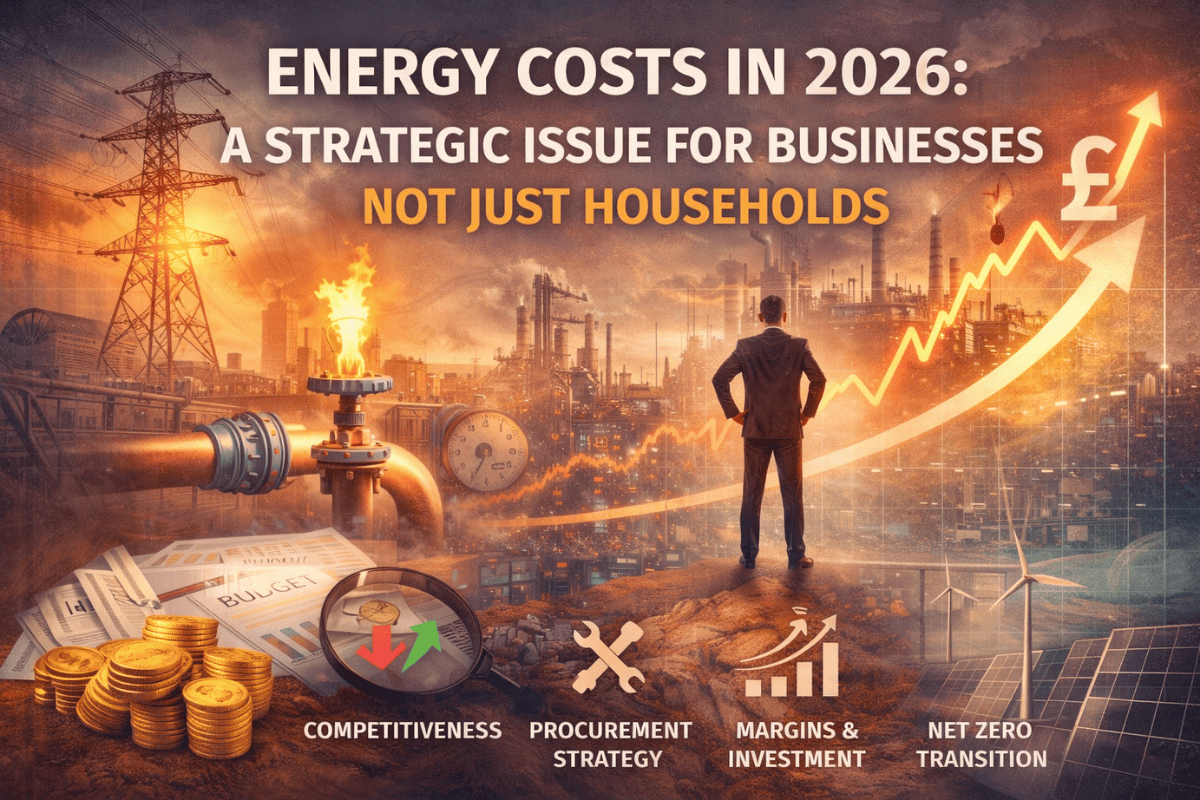
Energy is no longer just an operational overhead — it is a direct competitiveness factor.
While public debate often centres on household bills, businesses across the UK and globally continue to operate in a high-cost and volatile energy environment. In 2026, energy pricing remains a board-level issue, influencing margins, investment strategy and long-term resilience.
📊 Business Energy Price Snapshot (2026)
Indicative business electricity prices:
-
Global average: ~13–14p/kWh
-
Europe average: ~17–18p/kWh
-
UK typical range: 20–27p/kWh
(Significantly higher for businesses out of contract)
UK business gas prices currently average around 5–7p/kWh.
The gap is material.
UK businesses are frequently paying significantly more than global competitors — particularly when compared to North America and parts of Asia. For energy-intensive sectors, this differential directly affects cost competitiveness in international markets.
🔎 What Is Driving Elevated Energy Costs?
Several structural and market-driven factors continue to influence UK energy pricing:
🔹 Volatility in Global Gas Markets
Despite relative stabilisation compared to peak crisis levels, gas markets remain sensitive to geopolitical risk, supply disruptions and storage dynamics.
🔹 Electricity Pricing Linked to Gas
Wholesale electricity pricing mechanisms remain heavily influenced by marginal gas generation, amplifying exposure even as renewable capacity expands.
🔹 Network and Infrastructure Costs
Grid maintenance, expansion and system balancing costs are embedded within tariffs and continue to rise.
🔹 Environmental Levies and Carbon Pricing
Decarbonisation policy, carbon pricing mechanisms and regulatory obligations add structural cost layers.
🔹 Investment in Energy Transition
Large-scale investment in grid upgrades, renewables integration and storage infrastructure is necessary — but capital costs ultimately feed into pricing frameworks.
The result: structurally higher and more complex pricing dynamics.
🎯 Operational and Strategic Implications
For energy-intensive sectors — including manufacturing, logistics, construction and industrial processing — energy remains one of the largest operational cost categories.
This directly impacts:
-
Profit margins
-
Pricing strategies
-
Capital investment decisions
-
Location and reshoring considerations
-
International competitiveness
Energy exposure is no longer a secondary variable. It is a strategic constraint.
⚡ The Energy Transition: Stabilisation vs Short-Term Volatility
Over the long term, the transition towards renewable generation and electrification should reduce structural exposure to fossil fuel shocks.
However, in the short to medium term, volatility remains a core risk factor.
Businesses cannot rely solely on market normalisation — they must actively manage exposure.
🏭 What This Means for Procurement & Supply Chain Leaders
Energy procurement is now a strategic discipline.
Organisations should consider:
-
Structured contract strategies (fixed, flexible or blended models)
-
Indexed pricing mechanisms aligned with risk appetite
-
Hedging frameworks where appropriate
-
Supplier diversification and multi-site aggregation
-
Energy efficiency investment with measurable ROI
-
On-site generation (solar, CHP, storage solutions)
-
Integration of energy risk into ESG and decarbonisation roadmaps
Energy is no longer just a utility purchase — it is a resilience and competitiveness lever.
🔎 Conclusion
In 2026, energy costs represent more than a budgeting concern. They shape business viability and strategic positioning.
Companies that treat energy as a controllable risk — rather than a passive cost — will be better equipped to protect margins, maintain supply continuity and remain competitive in global markets.
At Procurement Tech, we support organisations in transforming energy volatility into structured sourcing and risk management strategies.
#Energy #BusinessStrategy #UKBusiness #Manufacturing #CostManagement #NetZero #Procurement #SupplyChain #EnergyTransition

0 Comments